
Skip to content

For contractors and buildersfrom $250

Contractor website design where your work does the selling

A quote can’t show the one thing homeowners most want to see: how your finished work looks. Before anyone lets you take out a wall or build an addition, they want to see jobs like theirs, check your license and insurance, and get a feel for how you run a project. Our contractor website design shows all of that on a phone, gives each kind of project its own page, and turns interest into estimate requests.

  • Your projects front and center
  • A 90+ PageSpeed target
  • The price in writing before work starts

How homeowners pick a contractor for a big job

A renovation means a big spend and weeks of living with the work, so nobody picks a contractor from one search. They take their time, and your website gets checked at every step.

  1. Step 1

    Search

    They search for the project, “kitchen remodel”, “basement finishing” or “home addition builder”, plus their town, and open several sites over a few evenings.

  2. Step 2

    Look at past work

    They look for jobs like theirs: photos of finished kitchens and additions, ideally before and after, and where each one was. A site with no projects on it gives them nothing to go on.

  3. Step 3

    Ask for an estimate

    When they’re ready, they describe the job: what they want done, a rough budget, when they hope to start. A form that asks for that tells you what you’re pricing before the site visit.

Referrals check too. Someone who hears your name from a neighbor still looks you up before they call, and your contractor website is where they land.

Web design for contractors, built to win the estimate

Every contractor website we build has these six parts, in the order a homeowner planning a big job looks for them. The numbers on the phone match the list.

  1. Your number on every page

    Some people want to talk a project through before they fill anything in. The call bar stays at the top as they scroll, so that conversation is one tap away.

  2. The work you take on, and where

    Renovations, additions, the town: the first line tells a homeowner they’ve found a contractor for their kind of job, and tells Google what the page is about.

  3. Proof for a big spend

    Your license or registration, insurance, any warranty on your work and real reviews, near the top. People are about to trust you with a large sum and their home.

  4. Projects sorted by type

    Kitchens, bathrooms, basements, additions: each links to its own page, with photos and details of jobs like it.

  5. Where you work

    The towns you cover, and the size of job you take on, so you hear from people whose projects suit you rather than every small repair in the region.

  6. An estimate form that qualifies the job

    Type of project, rough budget, when they hope to start and where. You know whether it’s a fit before you drive out to look.

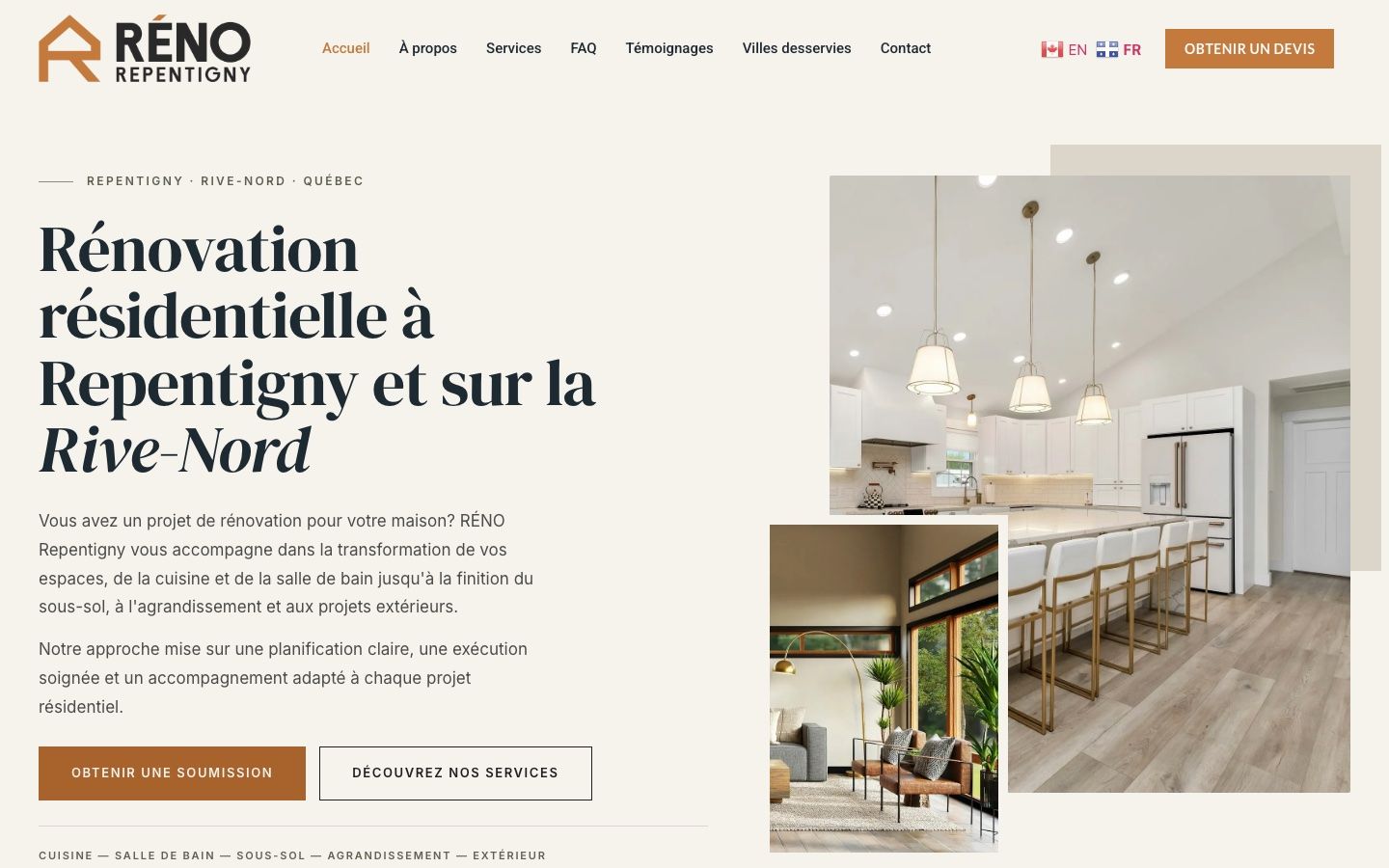
A real example: RÉNO Repentigny

Homepage of the RÉNO Repentigny website, showing the headline about residential renovation in Repentigny and the Rive-Nord

RÉNO Repentigny

Residential renovation contractor

Repentigny, Québec · Launched October 2026

What was built

  • French-language website with six service pages (kitchen, bathroom, basement, home extension, exterior, patio and outdoor kitchen)
  • 24 local pages for the towns it serves, from Terrebonne and Mascouche to Laval and Joliette
  • Online quote request page, testimonials page and FAQ
  • Analytics installed from day one
  • SEO for the site, also done by us

What clients say on Google

5.0Rated 5.0 out of 5.Based on 2 Google reviews

A page for every kind of project you build

A homeowner planning a kitchen searches “kitchen remodel” or “kitchen renovation” and their town. One planning an addition searches for that instead. A single services page listing everything has little chance of showing up for either.

So each project type you want more of gets its own page, with its own title, headings and description, and photos of jobs like it. Your best finished projects can have pages of their own too, with before-and-after photos and the story of the job. Which of these you need is agreed on the call, and it’s what the price is based on.

Inside the home

  • Kitchen remodeling
  • Bathroom renovation
  • Basement finishing
  • Whole-home renovation

Building out

  • Home additions
  • Decks and patios
  • Garage conversions
  • Roofing and siding

Your work

  • Project gallery
  • Before & after
  • Project stories
  • Reviews

What contractor website design costs

from$250

The figure depends mainly on how many pages the site has: the project types you offer, the towns you work in, and how many finished projects get a page of their own. A contractor doing kitchens and bathrooms in one town needs fewer than a builder taking on additions and full renovations across a region. You get it in writing after a free call, and nothing starts until you’ve agreed to it.

Content writing and ongoing maintenance aren’t included. The photos and the details of each job come from you; we turn them into project pages that stay fast on a phone, however many images they hold. Hosting after launch is available for a yearly fee.

Every project is scoped on a call. These are starting points, not quotes.

See the full home service website design package

Every project includes

  • Custom design and build, mobile first
  • Page speed optimization (90+ PageSpeed target)
  • Google Business Profile set up or fixed
  • On-page SEO: titles, meta descriptions, headings, schema, sitemap
  • Conversion tracking for forms and call clicks
  • Contact and quote form
  • A second language if you need one
  • Launch plus one month of support

Lead System

Covered in drywall dust when the next inquiry comes in?

You’re on site all day, and a homeowner with a kitchen budget is sending the same message to three contractors. The first to reply has a head start. The Lead System replies to every inquiry in under 60 seconds, 24/7, texts back the calls you miss, asks the questions you’d ask about the project, and sends you a short summary for when you’re off the tools.

See how the Lead System works
Contractor marking a new drywall wall against a spirit level, the kind of project good contractor website design brings in
Example conversation

Customer

We’re thinking of redoing the kitchen and maybe taking out the wall into the dining room. Could someone come and take a look?

Automatic reply, in under 60 seconds

Sounds like a good project. Roughly how big is the kitchen, and do you know if that wall is load-bearing? When are you hoping to start?

Websites for contractors: common questions

Something else on your mind? Ask it on the call. It’s free, it takes 15 minutes, and there’s no pitch.

Read the full NordClient FAQ

How much does a contractor website cost?

Our contractor website design starts at $250. Where it ends up depends on how many project types, towns and project pages it has, and whether you need a second language. The exact figure comes in writing after a free 15-minute call.

Do you do general contractor website design, or just remodelers?

Both. General contractor website design covers more project types and often commercial work, so the site usually has more pages, but the rules are the same: projects first, proof near the top, and an estimate form that qualifies the job. Builders and construction companies fit here too.

I don’t have good photos of my work. What can I do?

Start with the next job: take photos before, during and after, on your phone, in good light. A few honest photos of real work do more than any stock image. The site can launch with what you have, and new projects can go up as you finish them.

Do project pages help me show up on Google?

They can. A page about a finished kitchen in a named town, with real photos and a description of the work, is the kind of specific, original content that helps a site show up for “kitchen remodel” in that town. It also shows homeowners you’ve done jobs like theirs nearby.

Can my website bring in bigger jobs and fewer small ones?

It can help steer them. The projects you show, the services that get their own pages and the questions on the estimate form all tell people what you take on. A form that asks for the project type and a rough budget lets you see the fit before you give up an evening to a site visit.

Do I need a website if most of my work comes from referrals?

Referrals look you up too. Someone who hears your name will often search for you before they call, and a site with your past projects and reviews backs up the recommendation. No website, or an outdated one, can quietly lose work you’d already earned.

Do you build websites for contractors in my area?

Yes. We work remotely with contractors across the US, from Downey, Riverside and Huntington Beach to Moreno Valley. Each project type and the towns you build in can have their own pages, with photos of jobs like them, so homeowners nearby find you. We agree the pages on the call.